Plastic Surgeons: Your 5-Star Reviews May Not Be Helping You as Much as You Think
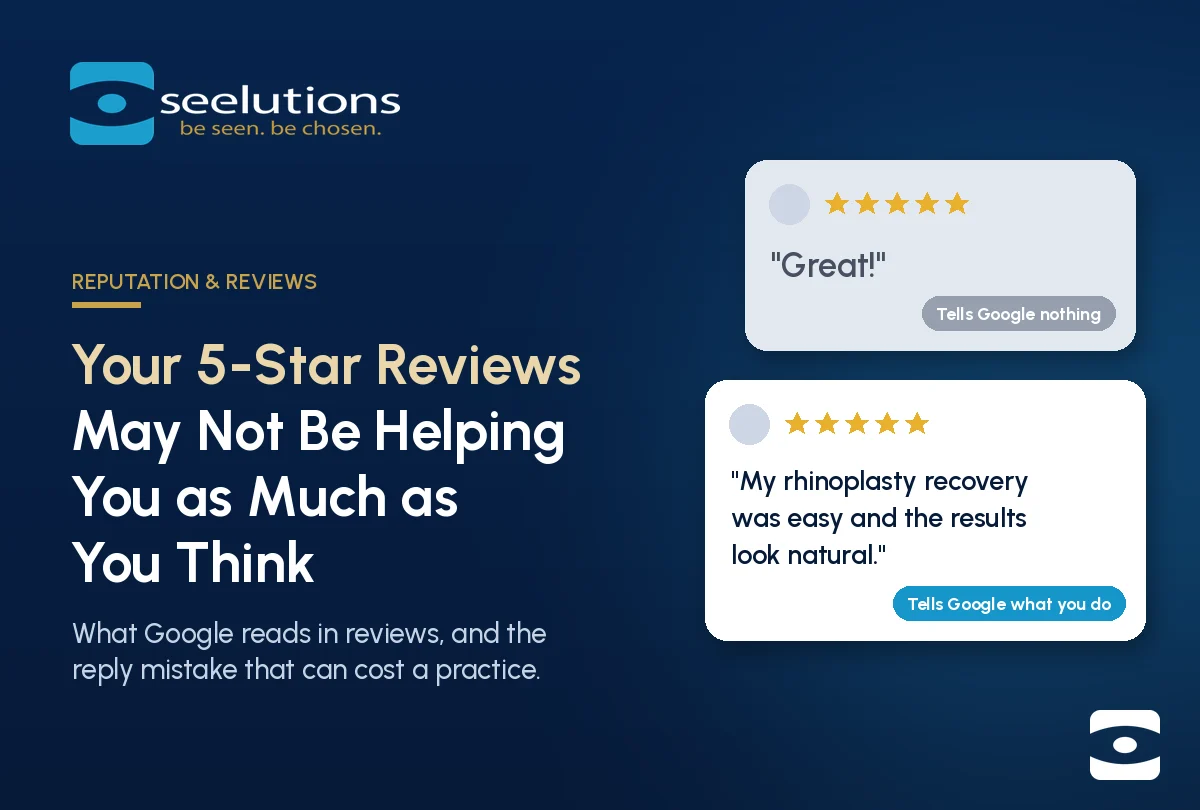
A wall of 5-star reviews is not the same as a strong reputation in search. Google and AI tools read the words inside your reviews to decide which procedures your practice is known for, and a review that only says "Great!" tells them almost nothing. The practices that win searches for rhinoplasty, facelift, or breast augmentation usually have reviews in which patients describe those procedures in their own words.
There is a second half to this, and it is the part that costs money. How your practice replies to reviews matters as much as what patients write, because a careless reply can turn a kind review into a federal privacy problem.
Why aren't my 5-star reviews bringing in more consultations?
Your star rating tells patients you are good. The text of your reviews tells Google and AI tools what you are good at. When a patient searches for a specific procedure, Google looks for evidence that your practice is relevant to that procedure, and review text is part of that evidence.
Google has grouped the words in reviews into topics since 2019, when it introduced a feature that uses machine learning to summarize what reviewers mention most. Those topics appear on your profile, and they shape which reviews a searcher sees first. A practice with 300 reviews that mostly say "amazing staff" and "highly recommend" gives Google very little to connect to "tummy tuck surgeon near me."
The volume still matters. BrightLocal's 2026 Local Consumer Review Survey found that 97% of consumers read reviews for local businesses, and 41% say they always read them, up from 29% the year before. Patients are reading the words. So are the machines.
What does Google actually read in a review?
Google reads the same things a careful patient reads: the procedure, the experience, and how the person felt about the result. Compare two reviews with identical stars:
- "Great!"
- "My rhinoplasty recovery was easier than I expected, and the results look natural."
The first one confirms you have a happy patient. The second one connects your practice to rhinoplasty, to recovery, and to natural-looking results, which are the exact phrases a prospective patient might type. When someone searches your profile's reviews for "rhinoplasty," the detailed review is the one that surfaces.
This is also why a competitor with fewer reviews can outrank you for a specific procedure. We covered that pattern in detail in why a competitor with worse reviews gets recommended first, and review content is a big part of it.
Google is also paying more attention on its own side. In October 2026, Search Engine Roundtable reported that Google is testing a rebuilt performance report in Business Profiles with a dedicated reviews section. Whether or not that test rolls out, the direction is clear: what patients say carries more weight than a raw average.
How do I get patients to write more detailed reviews?
Ask every patient the same way, and ask for their story rather than a rating. A simple, consistent invitation works best: "If you are comfortable sharing, we would love to hear about your experience in your own words." Then make leaving a review easy with a direct Google link or QR code.
Two limits matter here, and both come from Google's own review policy. First, no incentives of any kind. Discounts, gift cards, or credit toward a future treatment in exchange for a review are prohibited, and Google can remove the reviews and restrict your profile. Second, do not tell patients what to write. Google's policy says businesses should not request that specific content be included, which means you cannot ask a patient to mention "facelift" or your surgeon's name.
It also says not to selectively solicit positive reviews. Asking only the patients you know are thrilled is called review gating, and it is against the rules. The fix is a consistent process that asks everyone, which also happens to produce more natural, detailed reviews.
Where does the real risk come in?
The risk is in your reply. Patients are free to share their own health information in a review. Your practice is not. When you respond publicly, never mention the procedure, the patient's name, their treatment details, or anything that confirms they were your patient, even if they mentioned it first.
The American Medical Association puts it plainly in its guidance on responding to online reviews: do not disclose any information about the patient, and do not even acknowledge that the person is a patient in your office. HIPAA does not stop you from replying. It limits what a reply can say.
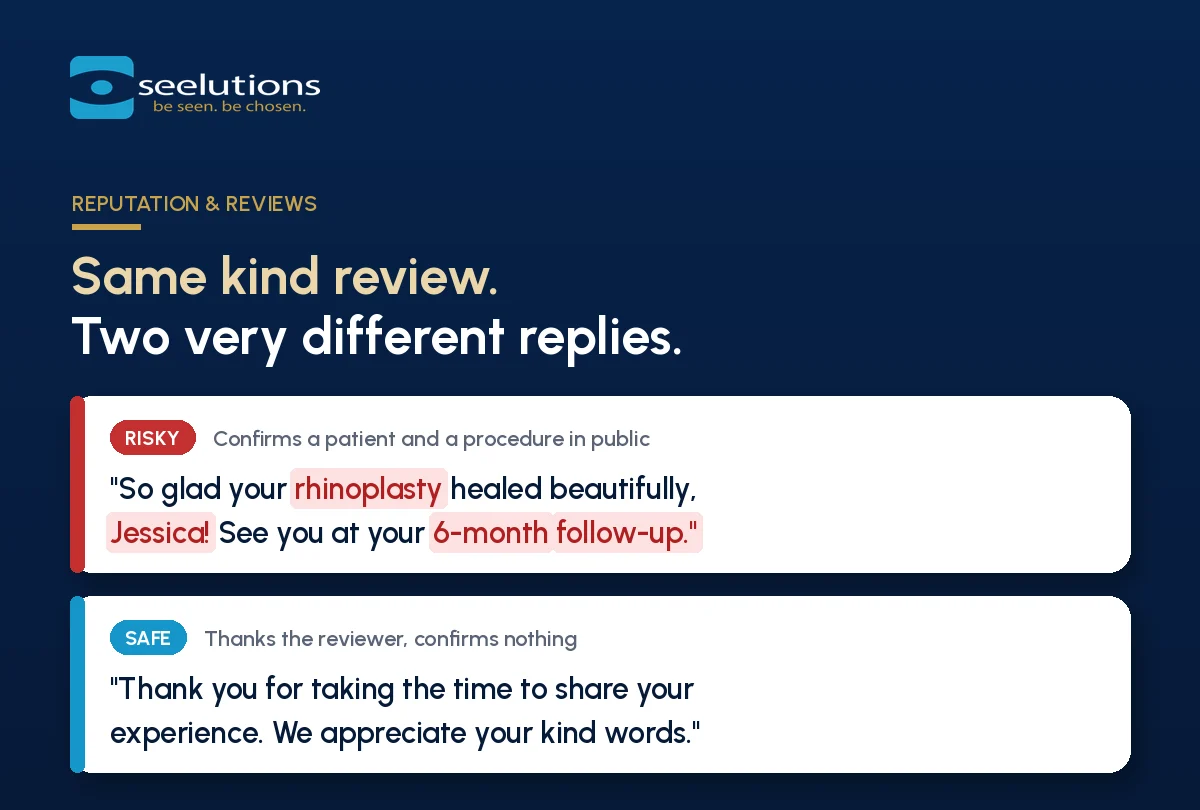
This is where well-meaning practices get into trouble. A grateful-sounding reply such as "So glad your rhinoplasty healed beautifully, Jessica!" feels warm. It also confirms a patient relationship and a procedure in public. On the negative side, the temptation to correct the record is even stronger, and that is where most enforcement cases have started.
Have practices actually been fined for review replies?
Yes. The U.S. Department of Health and Human Services Office for Civil Rights has settled more than one case over exactly this.
Elite Dental Associates in Dallas paid $10,000 in 2019. A patient complained that the practice's reply to her Yelp review disclosed her last name, details of her treatment plan, her insurance, and the cost. The investigation found the practice had disclosed other patients' information in its replies as well, and it agreed to a two-year corrective action plan with federal monitoring.
New Vision Dental in California paid $23,000 in 2022 after its replies to online reviews disclosed patient names, treatment, and insurance information. It also agreed to a two-year corrective action plan. In the HHS announcement, OCR said providers cannot disclose patients' protected health information when responding to negative online reviews.
Both were dental practices, but the rule applies to every HIPAA-covered practice, including plastic and facial cosmetic surgery. The dollar figures were modest. The corrective action plans, monitoring, and public record were not.
What does a safe review reply look like?
A safe reply thanks the person without confirming anything about them. For a positive review:
"Thank you for taking the time to share your experience. We appreciate your kind words."
For a negative review, keep it general and move the conversation offline:
"We take every concern seriously and would welcome the chance to talk with you directly. Please call our office at your convenience."
Neither reply mentions a procedure, a date, a provider, or a detail from the review. That can feel cold the first few times. It protects the practice, and readers still see a practice that responds.
The most reliable approach is a short set of pre-approved replies that your healthcare attorney or compliance officer has signed off on, used by whoever manages your reviews. That takes the judgment call out of a busy afternoon.
How do reviews affect AI search and ChatGPT recommendations?
AI tools lean on reviews when they decide which practices to name. BrightLocal's 2026 research found that the share of consumers using AI tools for local business recommendations climbed from 6% in 2025 to 45%. When someone asks ChatGPT for the best facelift surgeon in their city, the tool is summarizing what it can find and verify, and detailed reviews are some of the clearest evidence available.
A practice whose reviews describe specific procedures gives an AI tool something concrete to repeat. A practice whose reviews say "great" gives it nothing to work with. This is one reason review strategy sits inside our AI search visibility work rather than off to the side.
It also connects to where you invest. If facelift and rhinoplasty are your most profitable procedures, those are the procedures your reviews should naturally reflect, which ties directly to splitting your marketing budget by procedure.
Frequently asked questions
Can we ask patients to mention their procedure in a review?
No. Google's policy says businesses should not request specific content in reviews. Invite patients to describe their experience in their own words, and many will name the procedure on their own.
Should we reply to every review?
Replying shows patients you are listening, and Google encourages it. Every reply should stay general: thank the reviewer, never confirm they are a patient, and never mention a procedure or detail.
Is it a HIPAA problem if the patient mentioned the procedure first?
It can be. A patient sharing their own information does not give your practice permission to repeat or confirm it. Keep replies free of anything that confirms the patient relationship.
Can we offer a small thank-you gift for leaving a review?
No. Google prohibits incentives of any kind in exchange for reviews, and it can remove those reviews and restrict your profile.
How many reviews does a plastic surgery practice need?
There is no magic number. A steady flow of recent, detailed reviews tends to matter more than a large, old total.
Where should a practice start?
Start by reading your last 30 reviews and asking one question: does a stranger know what procedures we do from these? Then look at your last 30 replies and remove any that confirm a patient or a procedure. Those two checks tell you most of what you need to know.
This is the kind of review we build into local SEO and Google Maps for practices we work with, including Dr. Ryan Diepenbrock's facial cosmetic surgery practice, which has worked with us for more than ten years. You can see what that has looked like in our 10-year case study.
If you want to know what your reviews are telling Google, and whether any of your replies are putting the practice at risk, call (804) 707-5821 or book a free 20-minute Strategy Call with Langley. seelutions works with one plastic or facial cosmetic surgery practice per market.

This article is marketing guidance, not legal advice. Confirm your review and reply policies with your healthcare attorney or compliance officer.
Be Seen. Be Chosen!