Plastic Surgery Marketing in the AI Era: AI Can Get You Seen. Only You Can Get You Chosen.
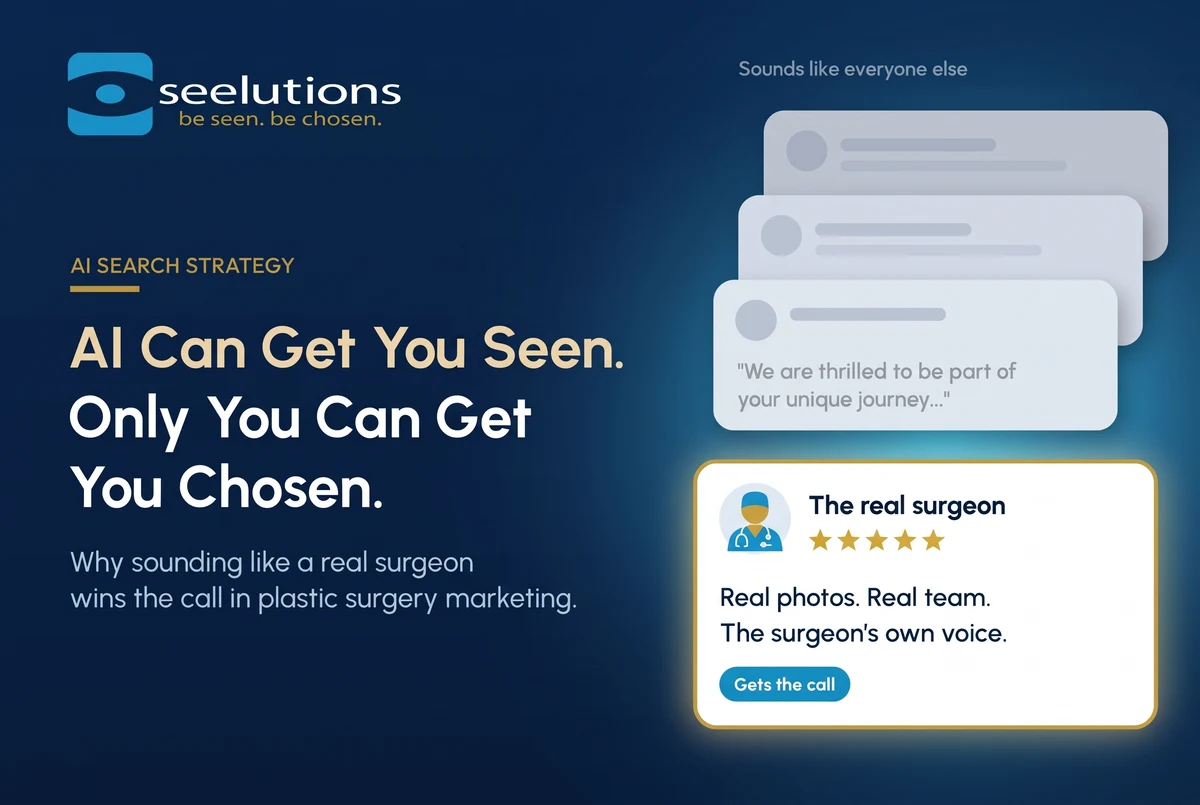
AI can help a plastic surgery practice get found. It cannot make a patient choose you. When every practice uses the same tools to write its website, its Google posts and its review replies, every practice starts to sound alike, and the one that sounds like a real surgeon gets the call.
That is the quiet problem behind a question we hear more and more from surgeons and practice managers: our rankings look fine, so why isn't the phone ringing the way it used to?
Why does a practice that ranks well still get fewer calls?
Because ranking and being chosen are two different steps. Ranking gets your practice onto the screen. Being chosen happens in the next ten seconds, when a patient reads your reviews, your replies, your photos and your first paragraph and decides whether they trust you with their face or their body.
A report can show a top-three position on Google Maps while that second step is failing. The patient compares you with two other surgeons on the same screen and calls someone else. And sometimes the ranking itself is the problem.
I learned this the hard way early in my career. When I first got into SEO, I lived in Virginia Beach, and about ten SEO companies were all fighting to rank for "Virginia Beach SEO." I got us to number one. The calls were not great, because the only people searching that phrase were other people in the SEO business. Not the plumber, not the HVAC contractor, not the plastic surgeon.
That lesson is a big reason we chose to specialize. When you know one industry deeply, you learn what real patients actually type, not what a generic AI tool guesses they type. Sometimes a procedure searched 10 times a month is worth far more than one searched 120 times, because it takes a specialized skill, few surgeons offer it, and the person searching knows exactly what they want.
How is AI making plastic surgery practices sound the same?
The same few AI tools now write a large share of practice websites, blog posts, Google Business Profile updates and review replies. They write fluently, and they write alike. The phrases repeat from practice to practice: "We are thrilled," "your journey," "state-of-the-art," "tailored to your unique goals." Patients comparing three surgeons in one sitting notice when all three sound like the same brochure.
It is not only the practices. One AI-detection company analyzed Google reviews of healthcare clinics and estimated that 28.9% of reviews for US plastic surgery clinics were likely AI-generated, the highest share of any healthcare category it studied. Whatever the exact number, patients are learning to spot polished, generic text, and they discount it.
Some signs are easy to spot once you look for them. Emojis sprinkled through a practice's posts. Long dashes in every other sentence, which our own team is told to avoid. Blog articles illustrated with images that carry no branding at all, sent straight from an AI image generator without anyone really looking at them.
Everybody uses AI these days, including us. The difference is what happens next. When we write an article for Dr. Diepenbrock's practice, AI helps with the draft, then I read it, our marketing director reviews and edits it, and Dr. Diepenbrock reads it himself. Some articles are approved right away. Some come back with changes. Three sets of eyes, because we want to be sure we are saying the right thing and not the wrong thing.
Why can common review-reply advice get a plastic surgeon in trouble?
Because most review advice is written for every kind of business, and plastic surgery is not every kind of business. A tip you will hear from people promoting themselves as local marketing experts is to make every reply personal: use the customer's first name and mention the specific job you did. For a roofer or a restaurant, that is good advice.
For a plastic surgeon, it is a HIPAA problem waiting to happen. A reply like "So glad you love your new nose, Jessica!" confirms in public that Jessica is your patient and names her procedure. Practices have paid for exactly that kind of reply. The U.S. Department of Health and Human Services settled with a California dental practice for $23,000 after its review replies disclosed patient names and treatment details, along with a two-year corrective action plan.
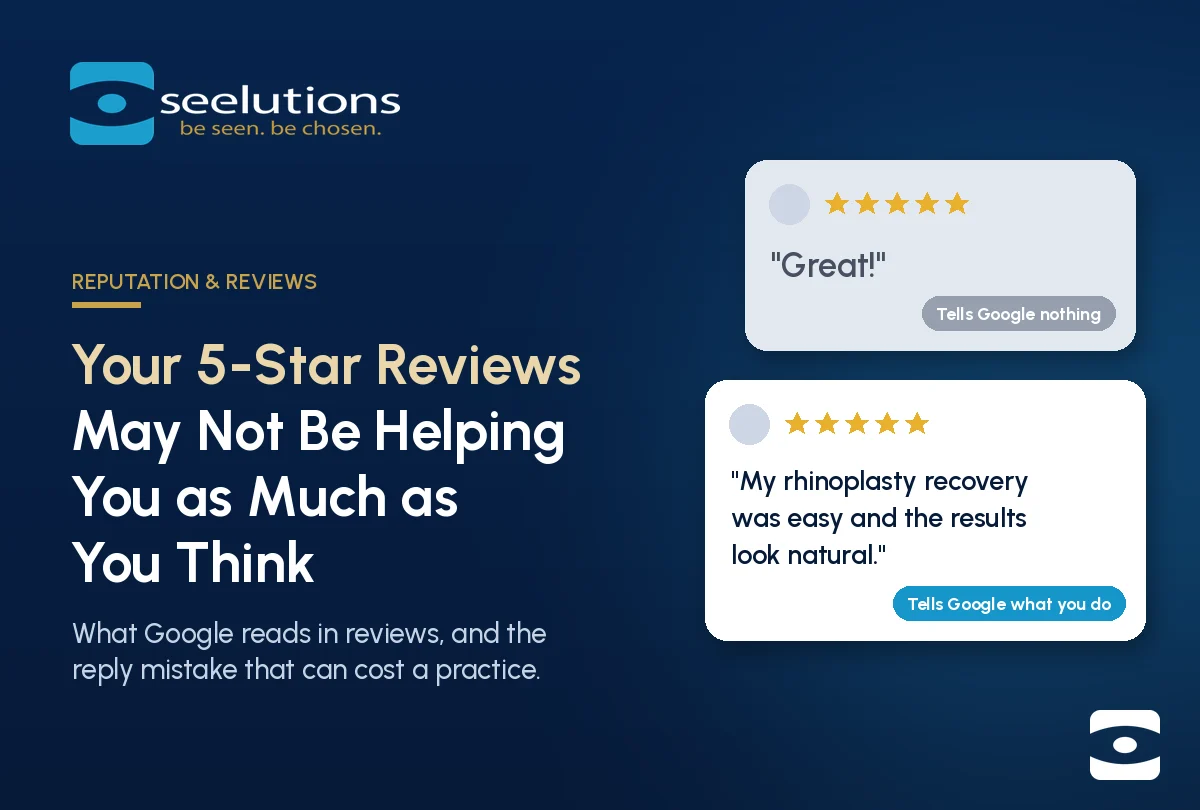
AI makes this worse, not better. Ask an AI tool to write a "warm, personal" reply and it will happily repeat the patient's name and procedure back to them. We walked through what a safe reply looks like in why your 5-star reviews may not be helping as much as you think.
This is why where you get your marketing advice matters. Advice built for every kind of local business will be right most of the time. In surgery, "most of the time" is not good enough.
What should patients see and hear from your practice?
Patients should see the real surgeon, the real team and the real practice, and hear the surgeon's own voice. Those are the things no competitor can copy and no AI tool can produce.
- Real photos. The surgeon, the staff, the consultation room, the front desk. Not stock models, and not AI-generated "results."
- The surgeon on video. Even a short, unpolished clip answering one common question tells a patient more than a page of perfect copy.
- The surgeon's own words. How they explain a procedure and why they do things the way they do.
- Replies that sound like a person. Short, warm and general. Safe does not have to mean robotic.
Dr. Ryan Diepenbrock, the facial cosmetic surgeon in Fort Wayne we have worked with since 2016, is a good example. His website and Google profile show his own face, his own work and his own words, and new patients now tell his office they found him on ChatGPT. You can see how that came together in our case study.
Part of it is simply who he is. Dr. Diepenbrock is a natural in front of a camera: believable, warm, with an easy smile, and very good at talking to people. His social media team regularly films short videos inside his office, and I like and share them because they show the real practice.
Where should a practice use AI, and where should it never?
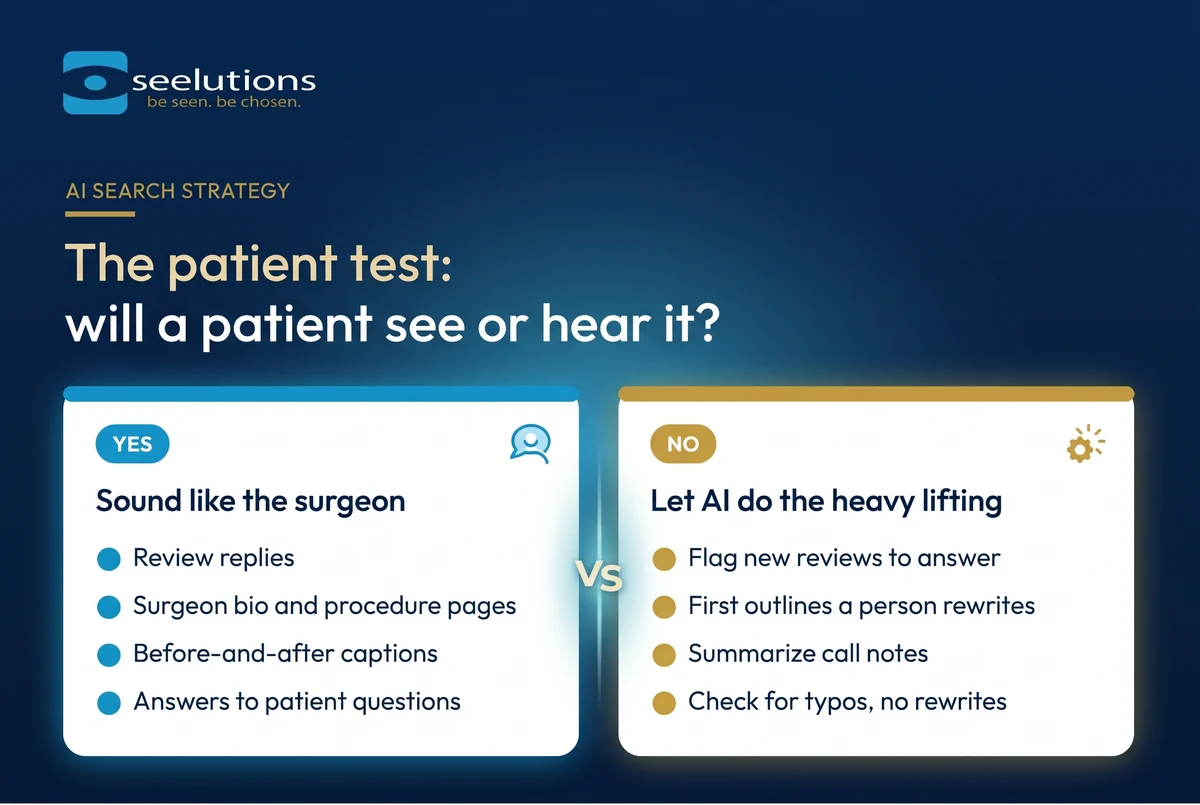
Here is the simplest test we know: would a patient ever see or hear this? If yes, it should sound like the surgeon and the practice, written or at least edited by a person who knows them. If no, let AI do the heavy lifting.
Good jobs for AI, behind the scenes:
- Flagging new reviews that need a reply
- Drafting a first outline that a person then rewrites
- Summarizing call notes to spot patterns
- Checking a page for typos without rewriting it
Jobs that should never go straight from AI to a patient:
- Review replies
- The surgeon's bio and procedure pages
- Before-and-after captions and patient stories
- Anything that answers a patient's question about their care
Our own rule at seelutions is simple. AI is a tool, not a set-it-and-forget-it fix. We use it every day, and we watch it closely, because it makes mistakes and it needs someone with an expert eye and deep knowledge of the field checking its work. I have seen one-click "SEO" programs, where you enter a website and press a button, do real damage to sites. Good SEO is not just numbers. It is part art: understanding the industry and what patients are thinking when they search. AI can speed that up. It cannot replace the years of experience behind it.
Does sounding human help with ChatGPT and Google's AI answers?
In our experience, yes. AI answer tools such as ChatGPT, Perplexity and Google's AI Overviews tend to recommend practices they can describe in specific terms: what the surgeon is known for, which procedures patients mention, what makes the practice different. Generic copy gives them nothing distinctive to repeat. Specific, real detail gives them something to say about you.
That is why we treat a practice's voice as part of AI search visibility, not a separate branding exercise.
The 10-minute patient test
Open your own Google Business Profile and website on your phone, as if you were a new patient comparing three surgeons tonight. Then check:
- Your last 10 review replies. Do they sound like a person? Does any of them name a patient or a procedure?
- Your photos. Can a patient see the real surgeon and the real team in the first five photos?
- Your homepage's first paragraph. Could a competitor paste it onto their site without changing a word?
- Your surgeon bio. Does it sound like how the surgeon actually talks?
- Video. Is there at least one short clip of the surgeon speaking?
If you answered "no" or "not sure" to two or more, patients are likely seeing a practice that looks like everyone else.
Frequently asked questions
Should plastic surgery practices stop using AI for marketing?
No. AI is useful for research, organization and first drafts. The line is anything a patient sees or hears: that should sound like the surgeon and be checked by a person before it goes out.
Does Google penalize AI-written content?
In its guidance on AI-generated content, Google says it focuses on the quality and helpfulness of content, not on how it was produced. The bigger risk for a practice is not a penalty. It is sounding like every competitor and giving patients no reason to choose you.
Where should a practice start?
If you only have time for one thing, start here: pinpoint the procedure you most want more of. Look for the balance between the procedures you love doing and the ones that are most profitable for your time. Money is not everything, but a practice has bills to pay. If you love rhinoplasty and the confidence a new nose gives a patient, let's find you more rhinoplasty patients. We go deeper on choosing those procedures in how to split a marketing budget by procedure.
Then run the patient test on just that procedure: its page on your website, its photos, and how your Google profile talks about it. When those pages were written mostly by AI, a rewrite in the surgeon's own voice is often the fastest win, and it pairs naturally with our work on local SEO and Google Maps.
It also explains a pattern we see often: a competitor with worse reviews getting recommended first. Very often, the practice that wins is simply the one that sounds most real.
If you want a second set of eyes on how your practice comes across, call (804) 707-5821 or book a free 20-minute Strategy Call with Langley. seelutions works with one plastic or facial cosmetic surgery practice per market.
This article is marketing guidance, not legal advice. Confirm your review reply and patient privacy policies with your healthcare attorney or compliance officer.
Be Seen. Be Chosen!